Zellij tile, carved cedar, hand-sculpted stucco, and the inward-facing garden of the riad — Moroccan architecture is a philosophy made visible, and it's still built by hand today.
Walk through the doorway of a Moroccan riad and something shifts. The noise of the medina falls away. Light filters down into a courtyard where a fountain murmurs and orange trees scent the air. Every surface — floor, wall, ceiling — carries pattern: hand-cut tile, lace-like plaster, painted cedar. This is not decoration for its own sake. It's a philosophy made visible.
Moroccan architecture is the product of centuries of blending — Amazigh (Berber) foundations, Roman and Byzantine echoes, Islamic geometry, and the refined Andalusian aesthetic brought by craftsmen fleeing Spain. The result is a visual language so distinct it's recognised the world over, yet still made today, by hand, exactly as it was a thousand years ago.
Zellij: infinity, one tile at a time
The most iconic element is zellij (or zellige) — mosaic tilework assembled from thousands of individually hand-chiselled pieces. Each tile is cut according to a precise gauge, glazed, and fitted into geometric compositions of radiating stars and interlocking polygons. Because Islamic art traditionally avoids depicting living beings, artisans channelled their genius into geometry instead — and these endlessly repeating patterns came to symbolise the infinite, a reflection of divine order.
The craft appeared in the region by the 10th century and reached its height under the Marinid dynasty in the 14th, when it spread across lower walls, fountains, minarets and floors. To this day, no two zellij installations are identical, and the work demands maâlems — master craftsmen — who train for years before they're trusted to cut.
Carved stucco and the scent of cedar
Above the tile line, walls dissolve into carved stucco (gebs) — plaster sculpted into arabesques, vegetal motifs, and flowing Arabic calligraphy so fine it resembles lace. It catches light and shadow in a way that makes solid walls seem to breathe. Higher still, ceilings are crowned with carved and painted cedarwood from the Middle Atlas, worked in geometric zouak patterns — the timber's warm scent part of the experience itself.
Then there is tadelakt, the polished lime plaster, burnished with stones and sealed with black soap until it gleams like marble and turns water-resistant — the secret behind the silken walls of Morocco's hammams.
"These elements are never purely ornamental. Their geometry expresses balance, infinity, and unity — space becomes both artistic and meditative."
The riad: a garden turned inward
The genius of Moroccan domestic architecture is the riad — a house built around an inward-facing courtyard garden. The word traces to the Arabic rawda, meaning garden, and the layout reflects a vision of paradise: a central court, often quartered around a fountain, planted with orange and jasmine.
It's also brilliant climate engineering. The courtyard pulls cooling air through the rooms, diffuses harsh sunlight into soft glow, and offers a private sanctuary of greenery in the densest quarter of the city. The plain exterior gives nothing away — all the beauty is turned inward, a perfect expression of a culture that prizes interior life over outward show.
From mountain kasbahs to imperial mosques
Moroccan building is not one style but many. In the south, the kasbahs and ksour rise from rammed earth (pisé) — fortified villages the colour of the desert that bore them, like the UNESCO-listed Aït Ben Haddou. In the north and the imperial cities, dynasties competed in grandeur:
- The Almohads favoured monumental scale and austere geometry — their Koutoubia minaret in Marrakech became the prototype for the square minarets that define Moroccan skylines.
- The Marinids built the great madrasas of Fes — Bou Inania, Al-Attarine — masterpieces of zellij, stucco and cedar surrounding contemplative courtyards.
- The Saadians reached for opulence, every surface of their Marrakech tombs carved, tiled and gilded.
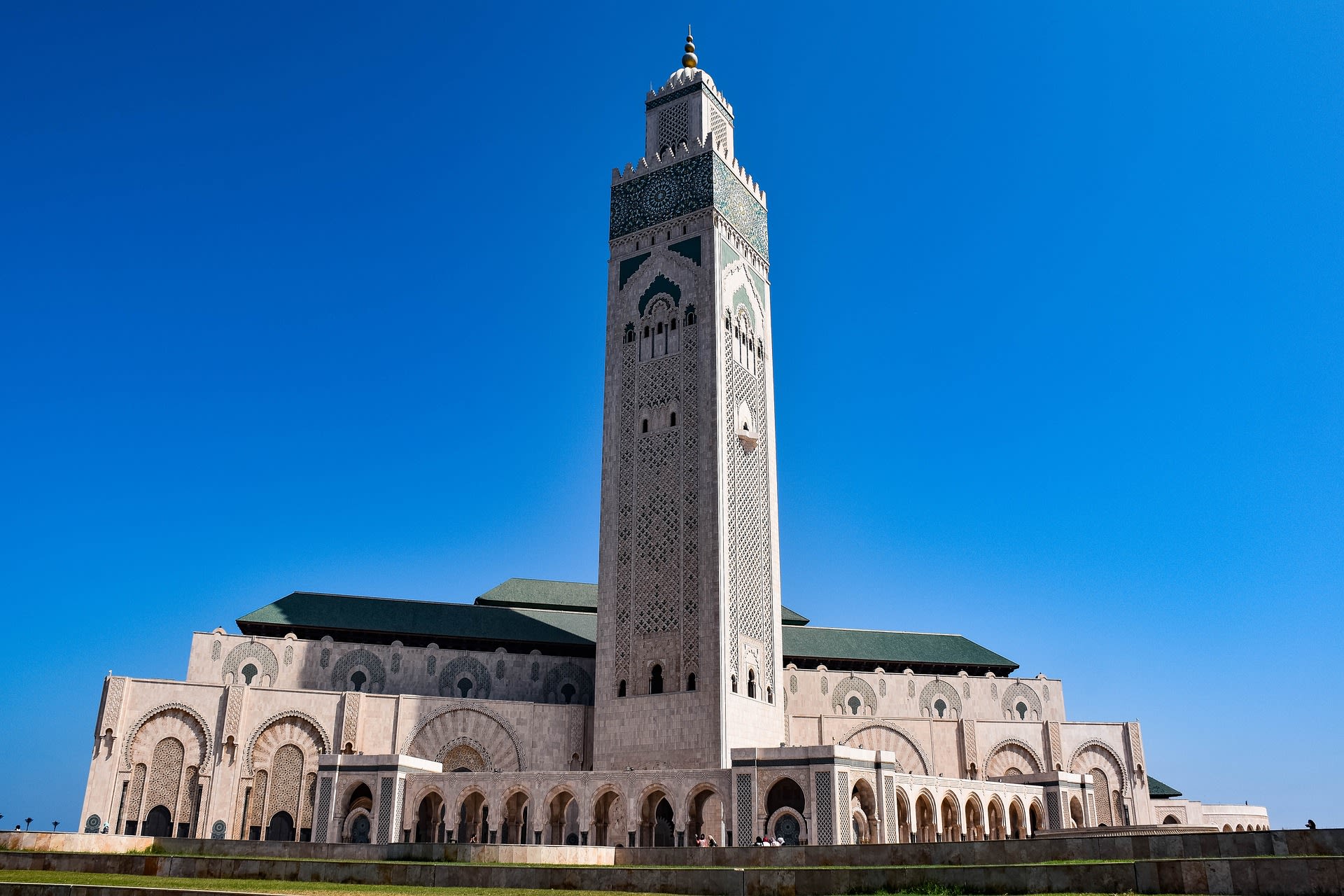
- The 20th-century Hassan II Mosque in Casablanca fuses it all — traditional handcraft and modern engineering, with a retractable roof and a minaret rising over the Atlantic.
◆ Insider tip
To truly understand this craftsmanship, visit a working artisan quarter — the zellij cutters of Fes, the cedar carvers of the Middle Atlas, the coppersmiths of Seffarine Square. Watching a maâlem at work is to see a living lineage, unbroken across centuries.
A heritage that still breathes
What moves visitors most is that none of this is frozen in a museum. The same families still cut the tiles, carve the cedar, and burnish the tadelakt. Stay in a restored riad, trace a zellij pattern with your eye, look up at a carved ceiling, and you're not admiring history — you're inside it. Moroccan architecture asks you to slow down, sit, breathe, and look up. Few places reward that so generously.